Mr. Bungle - CD collection
[21-02-2026]
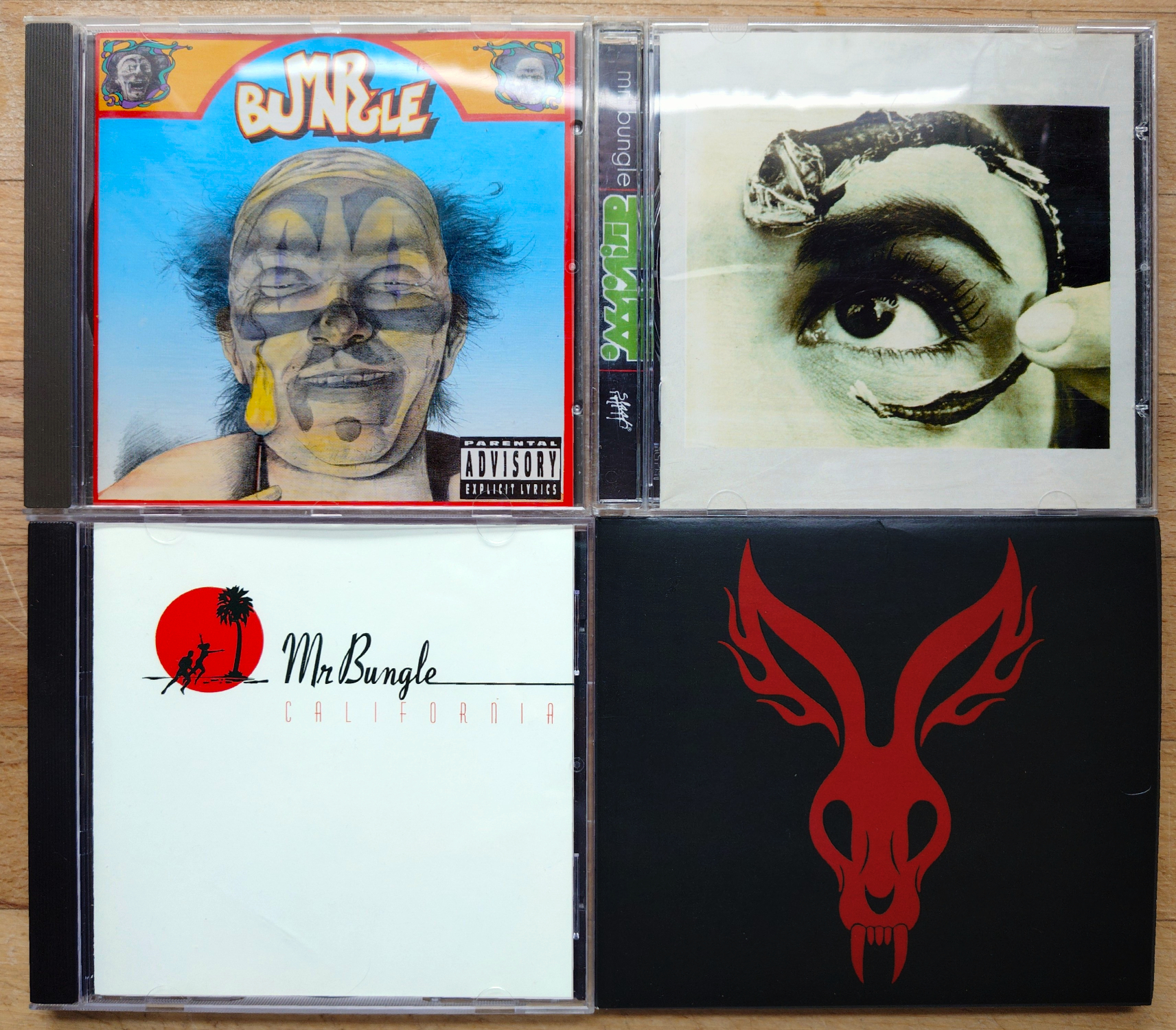
Mr. Bungle were founded in 1985, featuring, among others, all three key members that are with the band in each of its iterations: Vocalist Mike Patton, guitarist Trey Spruance and bassist Trevor Dunn. Initially playing thrash- and death metal, they quickly got bored of that, and started to incorporate more and more other elements into their music throughout the latter half of the 80s, eventually arriving at an experimental, oddball mixture of thrash metal, ska and funk. There is no official release of the band from the 80s, but they did put out a couple of demo tapes that document this early development.
Fellow SoCal proto-alt metal band Faith No More were looking for a new vocalist at the time, and got wind of Patton. Faith No More, who by that point already had major label backing, recorded The Real Thing with Patton, which released in 1989 and spawned the highly successful single Epic shortly after, the music video of which features Patton wearing a t-shirt with the logo of his other band, Mr. Bungle. Due to Faith No More's success, Patton had become a huge financial asset for their label, who, as a sign of good will, signed Mr. Bungle. This is how Mr. Bungle, a band playing deliberately off-putting experimental metal with not even a hint of desire to play the music industry game ended up on Warner Bros.
Now with major label backing, Mr. Bungle put out their first real release in 1991, the self-titled debut album Mr. Bungle. Mr. Bungle is a showcase of a band taking their metal roots and distorting them to be as weird as humanly possible. Thrash and death metal was infused with countless weird genre shifts to ska, funk, circus music, lounge jazz, movie samples. Songs change on a dime, give you whiplash, disorient you. It's in equal parts heavy and disturbing, as well as whimsical and goofy. The lyrics reflect this with an odd mixture of shock, horror, grotesque and humor. This album is incredibly iconic, laying out the blueprint for weirdo metal for at least the next two decades, with countless of artists from the nu metal era citing it as a primary influence, being one of the earlier reference point for combining ska with heavy music for the emerging ska punk / -core scene, and spawning a whole scene of other avantgarde metal bands with a similar blend of elements, none of whom manage to be quite as weird as this album. As much of an impact this album had artistically, one thing this album definitely didn't do is make Warner Bros. any money.
As far as my personal feelings about this album goes, I like it, particularly the hauntingly Evil Ska track Carousel, but I find it quite hard to listen to front to back. This is in one part because I approached this album from the wrong direction. I was already well aware of the impact I had, having listened to countless bands that take inspiration from it, so the blend of sounds on this album was already somewhat familiar territory for me and it didn't quite have the impact that it would've had if I heard it in the pre nu metal era. The other reason is I find it tediously lengthy. The 10 songs stretch over a duration of 73 minutes, and in my opinion they really don't need to. The songs aren't actually that long, it just wastes an extraordinary amount of time with film samples and recorded background noise in between songs. I understand that stretching out with ambiance is done to build an atmosphere and pace albums, and there's songs on here that create excellent dynamics and pacing with just that. But for example Egg, an already very long and disorienting song, ends at the 7 and a half minute mark, and then takes a whole 3 minutes to move on to the next track because they inserted 3 minutes of background noise at the end. There are other albums that use stuff like this to their advantage (Frances the Mute by The Mars Volta, in my opinion), but for me the style of this album does not lend itself to this kind of meditative listening experience, so it mostly comes across as an annoying waste of time. This album is iconic and extremely important, for good reason, I would recommend everyone listen to it. But do I personally love it? No.
An album I do love though is their second album, 1995's Disco Volante. While on the self-titled debut, the band seemed to have taken the foundation of heavy metal and transformed it into something weird and new, Disco Volante seems to exist on an entirely separate plane of existence from heavy metal. Although the album does contain some metal, it is shockingly little, and it no longer serves as the compositional foundation of the songs, but rather as just one tool in their gigantic tool box that they sprinkle in whenever it fits the mood. Disco Volante feels much more like an ambient album, or a movie soundtrack. It is not, but rather than attempting to write songs, however weird and loosely defined, here they write impressions, experiences, feelings. And the feelings it conveys are absolutely horrid. While it is true that this album meshes genres to an absurd degree, including many non-popular and non-Western types of music, the key to describing this album I think is by saying that it makes you feel on edge, paranoid, utterly baffled, alienated, sardonic and disassociated. This album gives me such a sick kind of joy of reveling in the feeling of being an unrelatable, freakish anomaly that will never connect to human society whatsoever. And even though this is very much a slow-burn album with much negative space and ambiance, it is also really damn entertaining and somehow, in parts, even catchy.
Going through the list of remarkable moments this album has to offer that I love seems like an overwhelming task but I will give it a shot. Carry Stress in the Jaw somehow features a smooth, seamless transition from a free jazz saxophone solo into thrash metal. Ma Meesha Mow Skwoz is a dadaist sound poem with absurd vocal acrobatics from Patton over a paranoid and frantic haunted carnival ride of a song. The Bends is a multi-part abstract jazz, electronica and ambient piece about a reckless diver's path to decompression sickness. Phlegmatics is a haunting ambient drone piece with a thrash beat. Desert Search for Techno Allah is somehow exactly what it says in the title. Violenza Domestica and Platypus (a carryover from the previous album) both feel like you chopped up a song into a thousand tiny pieces and put them back together in the wrong order, making you feel like you're having a stroke. Merry Go Bye Bye feels like an amalgamation of death metal songs that play through choppy reception as you're trying to find a radio signal as you drive through a vast, unknowable nighttime landscape. The only songs that somewhat keep you in touch with reality are the little easy listening number After School Special, which paints a subtle yet haunting picture of the horrors hidden behind the facade of a peaceful, domestic existence, and Backstrokin', a little surfy jazz piece about "fartin', pissin', and strokin' my fucking dick". The dynamics of the albums are also bizarre: If you bought this album in 1995, expecting a metal album, you'd be greeted with Everyone I Went to High School with Is Dead, the only real pure metal song on the album. And yet, it trudges along, hypnotically, on a completely intangible beat, and somehow, too quiet? It feels like it builds to something, a real song, but it doesn't. It's teasing you, giving you a metal song, but you can't quite grasp it. You can barely even hear it. When the song is over and the album transitions into Chemical Marriage, an instrumental piece that seems to mix something akin to game show jingles, doomy church organs, and light carnival background music, the mixing noticeably louder. Are they fucking with you? Most definitely.
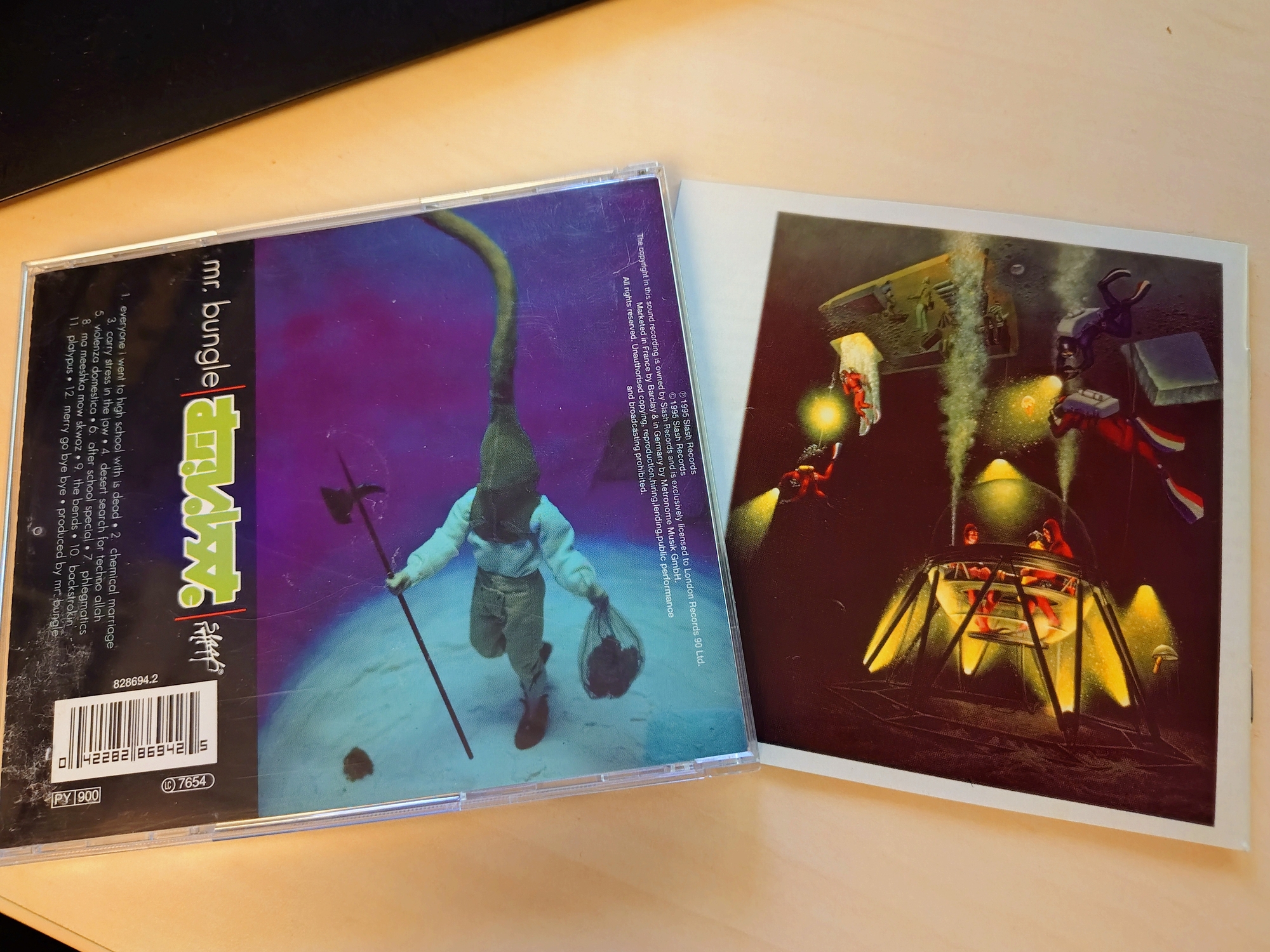
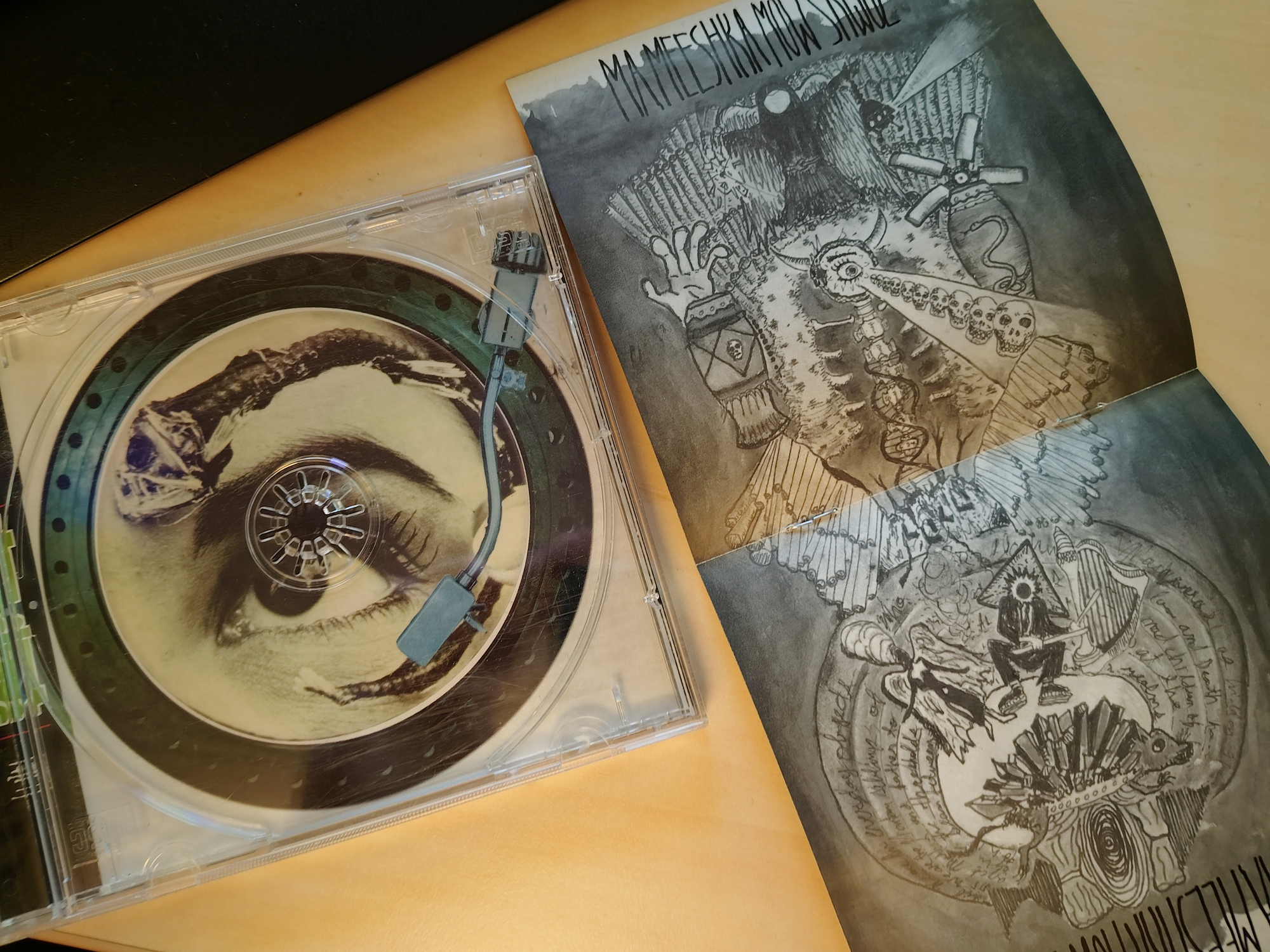
This album is also very long, but unlike the first album, none of its ambiance or negative space or nonsensical noise or weird samples make me feel like it's wasting my time. I said at the beginning that this album feels much more like an ambient album, which puts me into a different headspace listening to it. I don't want to just hear the songs, I am along for the ride of the whole experience of this album and want to experience it no matter how long it takes. This is one of my favourite albums of all time and I want every second of it, no matter how offputting it is in isolation. I am also absolutely in love with the art direction, which illustrates the alienating, surreal horror the album evokes. I also want to draw special attention to drummer Danny Heifetz and multi-instrumentalist Clinton "Bär" McKinnon, who have been with the band already on the previous album, but here, they really shine, as they are seemingly able to play everything under the sun with shocking, confident ease, making all of the bizarre trips this album take work as seamlessly as they do. McKinnon, by this point, has mostly replaced founding member Theo Lengyel ¹, who has taken more and more of a backseat as he was unhappy with the band's musical direction and eventually left the band less than a year after the release of the album, reportedly without having contributed to the songwriting.
The band returns 4 years later in 1999 with their third album, California. California is a very different beast than Disco Volante, but maybe not so different after all. This album is very inspired by surf, swing and lounge music and many of the songs go by without any sort of shocking twist that you would expect after the previous album. A lot of the songs on here sound normal, but watch out. It's less that the band has found god and decided to make normal music, it's more like a horrible, freakish monster wearing the skin of normal music, so don't let it catch you off guard. While there may be grandiosely smooth opener Sweet Charity or the deeply disillusioned but beautiful ballad Retrovertigo, there's tracks like The Air-Conditioned Nightmare, which quickly turns its saccharine Beach Boys stylings on its head, and the frantic Ars Moriendi or the completely disorienting Goodbye Sober Day operate on levels of absurd multi-genre chaos that rival the wildest moments on Disco Volante. Even the other deceivingly gentle ballad, Pink Cigarette, appears to distort and disintegrate into a black void of nothingness in front of your eyes.
California is much less of an overwhelming behemoth than its predecessor. At a playtime of under 45 minutes, it is much more focused and especially the adherence to more conventional song formats makes it much more accessible. Yet, it managed to recreate the haunting dissociation of Disco Volante nearly just as well with much less. This is not my favourite album, but I would recommend this one as a starting point. It won't tell you much about Mr. Bungle as a metal band, but it will tell you everything about what makes them special, with the lowest possible entry barrier.
After touring for California, the band split. Not definitively at first, but they went their separate ways and just didn't find back together. There's also reason to believe that the Red Hot Chili Pepper's Anthony Kiedis has something to do with souring the band on continuing. But I can't tell you anything about this that you can't read for yourself on wikipedia, so I will refrain from doing that here.
After nearly two decades of inactivity though, the band reformed, with all three core members from the beginning: Patton, Spruance and Dunn. Who wasn't there though were the other members I emphasized earlier for their skills and contributions, Heifetz and McKinnon, and neither were any of the common studio and live collaborators the band played with in the 90s. Instead, they are joined by two thrash metal legends, guitarist Scott Ian of Anthrax and drummer Dave Lombardo of Slayer. Not to discredit the guys, but they hardly seem like the right people to play the band's avantgarde, multi-genre style, so how's that gonna work? Simple! They simply don't play that music anymore. That's right, because the band had reformed in order to revisit their thrash metal roots, play thrash shows, and re-record their first demo tape from 1986, The Raging Wrath of the Easter Bunny, under the name The Raging Wrath of the Easter Bunny Demo, which has the very annoying side effect that now the professionally recorded album with an official release has "Demo" in its title, while the demo tape it is based on does not.
I have very mixed feelings about this new era of the band. I don't think it's fair to say that they're ruining the legacy of the band by doing something completely different now that I'm not as interested in or anything along those lines. I firmly believe that it should be within musicians rights to follow their artistic endeavours wherever it takes them. The thrash metal roots were always part of the band's identity even if it was easy to miss during their peak. And it features all of the core original members and they're playing their own songs that they wrote, in a style that they grew up with that they enjoy playing. I'm glad they're having fun. But at the same time, it feels wrong given the promotion this album and the related tours have been getting, while the 90s albums are laying dormant with no merch and no music videos. Ultimately, I think Easter Bunny is fine, I don't hate it, but as someone who is only a tangential fan of thrash metal, this feels just kind of like a slightly clichéd metal album to me that in the current moment in time appears to overshadow the music that made this band special.
I have no clue what the future of the band looks like. As it is going right now, it looks like it'll just continue as a fun touring act for Patton, Spruance and Dunn to jam some thrash every once in a while. But I have hope for them to return to their former glory: McKinnon and Heifetz have appeared as guest performers during their live shows, so they appear to still have a good connection to them, and on their most recent tour, they played Retrovertigo again, though in a truncated version. I vaguely remember hearing a recent interview with one of the core three that said something along the lines of that back in the day they had to work themselves up from straight forward thrash metal to the avantgarde band that they would become, and perhaps, if they keep at it, they can repeat that process. I don't think that's all too likely, but I can dream. If nothing else, I'd be very happy if the old albums could get some love again, at least. They don't have to play them, but some merch would be sick.
¹Unpleasant addendum:
In early 2024, founding member Theo Lengyel was charged with the murder of his girlfriend. This is nearly 30 years removed from his contributions in the band, which were waning and by the time of the second album, reportedly virtually nonexistent. The booklet of Disco Volante lists the individual songs with writing credits, with the addition: "Nothing: words by Lengyel, music by Heifetz" a joke at their expense for their nonexistent creative contributions, and shortly after the release of the album, Lengyel leaves the band. I'm not sure how involved he was earlier on, there's very little information on him as most of the band's history seems to center on Patton, Spruance and Dunn, but he does have a small handful of writing credits on the first album. He also does not seem to have had any involvement with the band or any of the members since. I wanted to add this addendum because I didn't wanna just pretend he didn't exist and I figured if I mentioned him it would be irresponsible to not also mention what he would go on to do. What he did was horrifying, but because of the above reasons it does not affect how I view the band and their albums as a whole, but if that sours your perception of them or the albums, I'm not gonna try to change your mind. As far as I can tell the rest of the band are good folks.